Showing posts with label Sewing. Show all posts

Friday, 15 April 2011

Not Couture But Still Professional


The Dressmaker’s Handbook Of Couture Sewing Techniques
Lynda Maynard

In A Nutshell: Ideal for an intermediate sewer with beautifully illustrated techniques for adding a professional finish to your homemade clothes

Strictly speaking, I’m not sure this book demonstrates many couture techniques but it does provide tons of useful hints for the intermediate seamstress. It’s ideal for someone who has basic sewing skills, and wants to learn processes that will embellish, or add a more professional finish to their homemade garments.

There is a nifty visual guide at the start showing all the techniques in the book. These have been arranged into three groups – bindings and finishes, visible design details and concealed design details.

The first group is mainly about ways to finish necklines and armholes, so for example, Lynda shows you how to create a banded v-neck on knit fabric. I learnt to stabilise the neckline with interfacing, and how to create a beautifully neat point, further enhanced with topstitching. Every step is illustrated with a super clear photo so they are extremely easy to follow, and convince you that equally professional looking results are within your capability.

I have seen many of the finishes Lynda explains on expensive tops in the shops. Using her instructions I will now be able to add that designer touch to my own T.shirts for a fraction of the cost. The chapter on visible design details also has a host of ideas that you could use to embellish existing clothes. How about adding a ribbon trimmed hem to a skirt, or ribbon trimming a collar band?

My sewing skills are at the stage where I learnt a lot from this book. It is less suitable for a beginner or someone who has been sewing for years.


Wednesday, 13 April 2011

Sewing With The Craft Goddess


Martha Stewart’s Encyclopedia Of Sewing And Fabric Crafts

In A Nutshell: A big satisfying book providing an introduction to many sewing skills and their application in 150 sophisticated projects.

This is a lovely big fat book, dense with information. It aims to please a wide audience which is it’s both great strength and weakness. There is bound to be something you would love to make, but equally vast tracts of the book will not match your taste or skill level.

The book begins with an introduction to sewing techniques, its usefulness dependent on your current knowledge. In covering so much ground, some subjects are merely touched upon and didn’t provide nearly enough information. I have a book dedicated to fabric reference so a section on fabrics seemed particularly sparse.

There are specific sections on appliqué, embroidery, quilting, patchwork, dyeing and printing. I rather enjoyed the section on dyeing and loved the ombre pattern used as an example. Not sure this would work quite as well if I tried it myself.

This is followed by an A to Z of projects, starting with Animals and ending with Wall Decor.
Projects always have that Martha element of sophistication, enabling you to create a shop-bought rather than a homemade look. Some are also very inventive and practical. I’m tempted to rush out and buy some oilcloth to make the lunch bags and cookery book covers. I did feel some of the projects would have benefited from more visual illustration to make more sense of some of the instructions. I was also disappointed with the clothing section, which is probably most suitable for beginners embarking on their first dressmaking project.

A CD included with the book includes some full-sized clothing patterns, and a host of templates to be used in the projects. As a UK reader all the  American birds used as motifs in several of the projects are meaningless me. I want Sparrows, Blue Tits and Robins not Bluebirds, Pelicans and Roadrunners.

Not without its weaknesses but another book to add to my Christmas present list. Though its currently available on Amazon for rather a good price.

Monday, 28 February 2011

Tie A Ribbon


Fashion Trims
Louise Turner

In A Nutshell: 30 projects, predominantly ribbon based, to create unique trims for your clothes and accessories

This is a big glossy book containing 30 projects to embellish your clothes and accessories. Louise Turner wants you to make something unique with simple techniques. Many of the ideas are based around ribbons, using them sewn on, ruched, and made into roses or rosettes.

Instructions are accompanied by a few photos, though I felt more diagrams or extra photos would make some of these clearer. I could not always work out exactly how to do something.

For the most part, projects are in good taste, though in a couple of cases I feel Louise has overstepped the boundaries. A ribbon decorated summer dress would only look good on a four year old or someone dancing round a maypole. A lace trimmed denim jacket and knickerbockers represent a serious style faux pas. Mixing in with these monstrosities, there are some lovely ideas. I love the personalised red espadrilles, circular skirt with cord circles and gathered ribbon scarf.

It’s also a good sourcebook for finding ideas to adapt. I’ve just spotted a shirt retailing for £229 embellished with cut ribbon work, a technique Louise uses on a cardigan. An easy way to create a designer look for a fraction of the cost. Let’s get trimming.


Tuesday, 22 February 2011

Sewing Green


Sew Eco
Ruth Singer

In A Nutshell: Highly informative book about the environmental impact of fabrics, but let down by dull, unoriginal projects

This book is all about putting the green into your sewing. The most interesting part is definitely the first few chapters, explaining the impact of various fabrics on the environment. Ruth’s aim is to help you understand all the issues involved to make your own choices for low impact sewing.

I learnt that cotton is from a sustainable source but has a high environmental impact with chemically intensive production and high air mileage. An organic fabric may have little chemical processing but is also high on air miles and not necessarily fair-trade.

There are also other good green sewing tips – try “upcycling”, turning something into a higher value item such as curtains into skirt. Dismantle charity shop buys such as keeping the lining and zip from a skirt for a future projects.

Ruth is obviously very knowledgeable about her subject and communicates the information well. I will certainly be taking the book’s advice into account in future fabric purchases. Yet I think it failed as a craft book. The 20 projects contain several ideas for using up fabric scraps but left me unenthused. Pincushions, felted tea-cosies and curtain skirts have all been done in better ways before. There is a hat which looks much better in its “before” version.

This book informs but doesn’t inspire.


Tuesday, 8 February 2011

Reimagine, Reuse and Reinvent


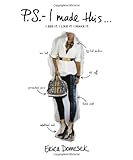
PS – I Made This
Erica Domesek

In A Nutshell: 25 ingenious projects for accessories and clothes to create your own New York style

I feel I am absorbing cool, hip New York style just by reading this book. Super stylist Erica Domesk claims to have DIY in her DNA and proves it with 25 runway inspired projects. Her philosophy is “Can you paint, embellish, cut, add to or adorn something similar to get the look or feel you’ve just fallen for?” I like to think I have a similar attitude but have only a fraction of Erica’s creative ingenuity.

She shows you how to make a variety of innovative jewellery, accessories and clothes. Some were a step too far for me – I certainly couldn’t imagine wanting to wear a string of bouncy balls in a pair of tights around my neck. Others, like the cork earrings, ring necklace and rhinestone studded heels were much more covetable. I’ve seen jewel encrusted shoes in the shops this spring, and a glue gun may be just the way to get the look for a fraction of the cost.

Erica’s trademark is to include mood boards for each piece, showing the inspiration behind each project. They immediately make you want to design your own.

The book also contains some interesting website suggestions, though the shopping sites would be of most use to American readers.

If the book leaves you wanting more, you can check out Erica’s own website.  


Wednesday, 2 February 2011

Restyling A Classic Piece


Vogue Sewing
Revised and Updated

In A Nutshell: Elegant and stylish book explaining the sewing techniques required to achieve a professional standard.  

I feel I am treading on hallowed ground in even attempting to review this classic book, originally published more than 40 years ago. Its high reaching aim is to elevate the craftsmanship of an amateur sewer to a professional level. As such, it has a wide scope, taking a beginner from analysing their figure, choosing a pattern and fabrics, sewing equipment, pattern alterations, construction techniques, tailoring and adding a custom touch.

One of my favourite chapters concerns fashion analysis and explaining the fundamental concepts of design. This section puts many “How to Dress” books to shame with useful pointers in choosing flattering and attractive outfits. I particularly enjoyed the exposition on the use of line and in future I will be thinking much more carefully about my use of horizontals and verticals.

This is an elegant and stylish book which I am pleased to have on my bookshelf. However, I have to admit this is not my go-to reference book when I want to look up a sewing technique. That honour belongs to the Readers Digest Complete Guide to Sewing which has the edge in providing detailed and clear explanations.

The Vogue book would have benefited from more photos. For example, a lovely chapter on creative trims is illustrated with line drawings. These are charming but I would have been more inspired by an actual photo.

Despite a few drawbacks, Vogue Sewing is a beautifully written book well worth adding to a sewing library.


Thursday, 13 January 2011

Hats Off


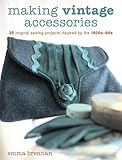
Making Vintage Accessories
Emma Brennan

In A Nutshell: 25 vintage inspired accessories to make in fresh modern fabrics

Accessories can make or break an outfit. In these straightened times, it may be overindulgence to splurge on complete outfit, but buying a bag or hat is still permissible. Even more brownie points if you make something yourself.

Emma Brennan’s book fits the mood of the moment, and also pays homage to the current fascination with vintage. Her 25 patterns for an assortment of handbags, hats and other accessories, are inspired by the 1920s to 1960s period. The designs are given a current twist by remaking in modern fabrics like wool tweed, polar fleece and fake fur.

The book assumes basic sewing skills, but gives clear explanations for many of the required techniques, such as fasteners, lining and pockets. Patterns are provided that require 200% enlargement on a photocopier.

Every time I flick through this book I find something new I want to make. I now have a burning desire to make a hat. I’m particularly attracted to “Iris”, a 1950s style hat with bow trim. The author describes it as a smart alternative to a beanie. It looks reasonably simple to make, and a good place to start my millinery career.  I was also delighted to discover that at 22 inches, my head is a standard size so all the patterns in the book should fit me perfectly.

With the help of this book I’m looking forward to creating several original accessories to provide the finishing touch to my outfits.


Wednesday, 12 January 2011

I'm Waiting For The Invitation


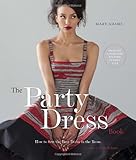
The Party Dress
Mary Adams

In A Nutshell: Design inspiration to create a unique party dress

I don’t have any party invitations on my mantelpiece at the moment, but I’m hoping Mary’s book will prepare me, should an occasion arise.

I was unfamiliar with designer Mary Adams, so this book was my introduction to her work. She has a distinct style, something akin to a prom queen with an edge. Imagine the singer Pink in a dress. It’s not a look for the pared down sophisticate. I enjoyed the sneak peek into Mary’s design background, and seeing the inspirations for her various collections.

To create a truly original design, Mary explains the techniques for several details that create the signature style for her work. She subverts traditional crafts like quilting and appliqué to create something exciting and modern. I was particularly enamoured with the layering of bias strips, to create a unique textured fabric. She also instilled in me a desire to sew ruffles on everything.

One could complain that this book comes with only one paper pattern, but that would be missing the point. Rather than be restrictive, this one design provides a springboard for endless creativity. The pattern in question has a fitted bodice with circle skirt, and comes in American sizes 4-14 (33” to 40” bust). Mary suggests three versions of her dress - Soaked Silk Taffeta, Cotton and Layered Silk Organza (detailed instructions are provided for the latter version).

Although titled a party dress, I think one made in a pretty cotton print would make a charming summer dress. I’m looking forward to re-creating some Mary Adams designer style for my holiday whilst I wait for my party invite.


Monday, 10 January 2011

Practical Make Do And Mending


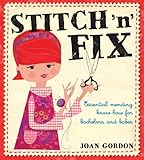
Stitch ‘N’ Fix
Joan Gordon

In A Nutshell: Beginner’s reference guide to mending using both hand and machine sewing

“Make do and mend” is becoming one of the key mantras of the day, and this book shows you how to do just this. It covers many basic repairs from buttons, zips, seams, hems, holes and a miscellaneous assortment of others – creating an hourglass shape in a shirt, removing a skirt waistband, and turning a pleat into a dart. It’s not exhaustive – I looked in vain to find how to shorten a sleeve but I can’t complain at lack of content. Each of the procedures is explained with clear instructions and accompanying photos.

This book is most useful to a sewing novice as it starts from the most basic level – how to thread a needle. I’m an intermediate sewer so already know how to undertake most of the processes. Saying that, I still learnt some useful snippets. I had not thought to tighten a gaping neckline by edging with blanket stitch, but this would be both useful and decorative.

A bonus of the book is that Joan suggests many quick fixes. A hem can be temporarily held up with staples, safety pins, or double sided sticky tape. Many repairs are explained using both hand and machine sewing. So all in all a great reference book for a novice sewer wanting to learn how to repair their clothes.


Tuesday, 30 November 2010

Beginner's Only


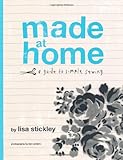
Made At Home
Lisa Stickley

In a nutshell: Basic introduction to home sewing with simple projects that would suit the sewing novice

Lisa Stickley has established a successful brand selling home textiles, china and bags. Now with this book, her fans can create homemade versions of her products. It is divided into two sections. The first part covers basic sewing techniques such as seams and inserting a zip. This is followed by several projects for household items to make grouped by kitchen, living room, bedroom and laundry.

As an intermediate seamstress, I found little to learn from the techniques section. In fact I wasn’t convinced that the author was an authority on sewing. I felt there were some glaring omissions from the techniques section such as making a mitred corner. On the plus side, the author’s trademark quirky illustrations are charming and the instructions are very easy to follow. But all the projects are basic, the only originality is in the use of Lisa Stickley’s own fabric designs. It certainly didn’t make me want to rush to the sewing machine.  This book would suit a complete beginner, but I would recommend Lotta Jansdotter’s “Simple Sewing” as a more interesting alternative. I borrowed Lisa’s book from the library and I will not be buying my own copy.


Thursday, 25 November 2010

Something For The Weekend


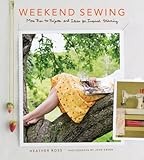
Weekend Sewing
Heather Ross

In A Nutshell:
Simple, weekend inspired sewing projects with interesting twists.

Heather Ross takes her inspiration from the weekend, both as a time to sew, and to use the projects in this book.

It starts with some good tips on designing a sewing space. Wish mine looked like the one shown in the book!

The 40 projects provide a great selection of items for women, children and the home. They are often very simple, but with a twist to make them special. I have made the headscarf which has a hidden elasticated insert that transforms it from frumpy to fashionable. Though admittedly it would suit a younger woman more than me! I’ve earmarked the summer blouse as a project for next year.

One point to note is that the clothing patterns are only suitable for women of a certain size (36” to 42” bust), unless you are adept at altering. Full sized paper patterns are provided so there is none of that pesky printing out used by some books.

This book does have some lovely photos – they have an aspirational lifestyle quality but still give a very clear view of the item.

There is a final chapter on sewing basics. This includes a great tip on choosing fabrics, and the difference between drape and body to create the silhouette you want.

All in all, a useful sewing book with something for both the beginner and experienced sewer.

Wednesday, 17 November 2010

All About Fabrics And More


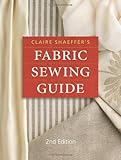
Fabric Sewing Guide
Claire Shaeffer

In A Nutshell: Invaluable reference book, dense with fabric information and sewing techniques

Many of my sewing disasters have stemmed from an incorrect choice of fabric so I am hoping this book will minimise future errors.

I was fascinated recently to read in the recent “Teach Yourself to Sew” magazine published by Taunton that Claire Shaeffer had started her career in the circus. The entertainment industry’s loss is sewing’s gain as she certainly knows her stuff. The title of this book does not do justice to its content. It is dense with information, not only a comprehensive reference book about fabric, but chock full of useful sewing techniques.

I recently purchased some silk chiffon to make a blouse. Although a beautiful fabric, I could tell it was not going to be easy to work with, so I checked out Claire’s advice.

The information on fabric has been divided into two chapters – one on fabric content and one on fabric structure. This means there are two ways I can look up my particular fabric. Firstly it is under “silk” in the Content Chapter, or alternatively as “Soft and Sheer” in the Structure Chapter. With both methods I am given a mass of information on how to use the fabric, including how to cut the fabric out, what machine needle to use, the stitch length and several possible seams. I am not surprised to find Claire believes my fabric is one of the most difficult to sew, though I pick up several useful tips. For example, I have to secure the threads at each end of a seam with a knot, rather than backstitching.

I next go to the chapter on sewing techniques, so I can find out more about some of the techniques Claire has suggested. I want to know how to create a standing fell seam, one of the types recommended for my fabric. I not only found how to do this particular seam, but many more I never knew existed. I feel quite depressed at my lack of sewing knowledge, though it is bound to improve if I constantly use Claire’s book.

My main criticism of this book is the lack-lustre photos. Considering this book was published in 2008, the designs featured are old-fashioned and uninspiring.

Despite this drawback, this book is one I intend to refer to whenever I start a new sewing project. My silk chiffon will still be difficult to work with but I am confident I am tackling it in the most effective way.

Saturday, 13 November 2010

Bagging It Up


Irresistible Bags
Marie Claire Ideas

In A Nutshell: A gem of a book with 45 wonderful ideas for homemade bags combining interesting materials with a variety of crafts

Bags have achieved cult status in the fashion world where some iconic brands have a waiting list of months and a price tag more than most people’s monthly salary. This book will not get you any closer to a Hermes “Birkin” or a Mulberry “Alexa” but it does provide 45 wonderful ideas for homemade bags that will not leave you out of pocket. Make the “Silver Diamonds” sequinned evening bag to provide the perfect finishing touch to a party outfit. Or if you would rather tackle something more practical, how about some rather striking saddlebags for your bike? A whole host of different crafts are brought into play - sewing, knitting, crochet, appliqué and embroidery – so there should be something of interest, whatever your creative preference. This is combined with imaginative use of a variety of materials – tarlatan, tartan silk, beads, sequins and leather – to make some unique creations. Some projects can be whipped up in a couple of hours, whilst others will require more time and patience.

This book is not without fault. It would be improved if there was a short text description of each bag, as it is not always possible to glean everything you need to know from the photo. The instructions would also benefit from diagrams as I did not always find them easy to follow.


As someone who has developed intense plastic carrier bag phobia on my supermarket trips I decided to make the hessian “Spring Collection” shopping bag. I am happy with the finished result but did find the open weave nature of hessian difficult to work with. It frays very easily so I would use an alternative fabric in future.

I may never own a designer bag but at least I have a homemade original.


Tuesday, 9 November 2010

Sewing Scandinavian Style


Simple Sewing
Lotta Jansdotter


In A Nutshell: Simple but sleek and stylish sewing projects that will bring Scandinavian charm to your home

Scandinavian born, self-taught designer Lotta Jansdotter aims to provide readers with useful and uncomplicated sewing projects. 24 are included in this book (10 with pattern sheets provided), themed by “Cook”, “Go”, “Nest” and “Organise”. There should be something to appeal to everyone with a diverse range of items including a sunhat, a yoga mat and a magazine holder.

I think the designs are lovely, reflecting the cool, clean lines of Scandinavian style. They are simple and straightforward, but often with interesting twists that elevate them out of the ordinary. The picnic placemat has practical pockets and a ribbon that make it decorative but inherently practical.

The projects are graded 1-4 in terms of difficulty level. I jumped straight in and made the reversible apron, classed as a “4”. It took a little time to make but I had no problems whatsoever, giving me confidence I could make anything in the book. The apron has a paper pattern provided, and I was impressed with the design. It has a lovely fitted shape that is extremely flattering, giving me that domestic goddess feeling.

This book would suit both beginners and more experienced sewers. I would definitely recommend it.