Monday, 28 February 2011

Tie A Ribbon


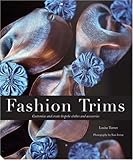
Fashion Trims
Louise Turner

In A Nutshell: 30 projects, predominantly ribbon based, to create unique trims for your clothes and accessories

This is a big glossy book containing 30 projects to embellish your clothes and accessories. Louise Turner wants you to make something unique with simple techniques. Many of the ideas are based around ribbons, using them sewn on, ruched, and made into roses or rosettes.

Instructions are accompanied by a few photos, though I felt more diagrams or extra photos would make some of these clearer. I could not always work out exactly how to do something.

For the most part, projects are in good taste, though in a couple of cases I feel Louise has overstepped the boundaries. A ribbon decorated summer dress would only look good on a four year old or someone dancing round a maypole. A lace trimmed denim jacket and knickerbockers represent a serious style faux pas. Mixing in with these monstrosities, there are some lovely ideas. I love the personalised red espadrilles, circular skirt with cord circles and gathered ribbon scarf.

It’s also a good sourcebook for finding ideas to adapt. I’ve just spotted a shirt retailing for £229 embellished with cut ribbon work, a technique Louise uses on a cardigan. An easy way to create a designer look for a fraction of the cost. Let’s get trimming.


Wednesday, 23 February 2011

Trash Into Treasure


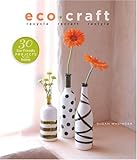
Eco Craft
Susan Wasinger

In A Nutshell: Ingenious book repurposing discarded items into stylish objects for the home.

This book took my breath away with its sheer ingenuity. It’s all about looking at the stuff you would normally discard and meditating on its possibilities for transforming into something completely different. So the 30 projects are based around rubbish – plastic 6 pack holders are melted together with an iron to produce a screen. Metallic coffee bags are taped together into a tote bag. Plastic milk jugs become a tulip shaped pendant light.

The book is beautifully illustrated – objects may be created from trash but the photos look like they belong in a high end interiors magazine.

My only criticism is that many of the projects would require a patience and skill level far beyond my capacity. Though admittedly there are easy projects such as pulped paper bowls.

The project I’m most keen to try is the painted jars. Blackboard paint transforms empty glass jars into a designer-look item. It’s a great idea for unifying a mish-mash of jars.

Susan Wasinger has inspired me to look at my “rubbish” with fresh eyes and consider its reincarnation possibilities.


Tuesday, 22 February 2011

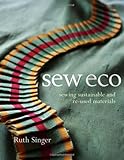
Sewing Green


Sew Eco
Ruth Singer

In A Nutshell: Highly informative book about the environmental impact of fabrics, but let down by dull, unoriginal projects

This book is all about putting the green into your sewing. The most interesting part is definitely the first few chapters, explaining the impact of various fabrics on the environment. Ruth’s aim is to help you understand all the issues involved to make your own choices for low impact sewing.

I learnt that cotton is from a sustainable source but has a high environmental impact with chemically intensive production and high air mileage. An organic fabric may have little chemical processing but is also high on air miles and not necessarily fair-trade.

There are also other good green sewing tips – try “upcycling”, turning something into a higher value item such as curtains into skirt. Dismantle charity shop buys such as keeping the lining and zip from a skirt for a future projects.

Ruth is obviously very knowledgeable about her subject and communicates the information well. I will certainly be taking the book’s advice into account in future fabric purchases. Yet I think it failed as a craft book. The 20 projects contain several ideas for using up fabric scraps but left me unenthused. Pincushions, felted tea-cosies and curtain skirts have all been done in better ways before. There is a hat which looks much better in its “before” version.

This book informs but doesn’t inspire.


Tuesday, 15 February 2011

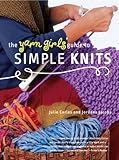
Chunky Knitting


The Yarn Girls’ Guide To Simple Knits
Julie Carles and Jordana Jacobs

In A Nutshell: Simple knitting patterns in chunky wool that may suit a beginner looking for super fast results.

I really enjoyed the “Yarn Girls’ Guide to Beyond The Basics” so I was motivated to hunt out their earlier work. Unfortunately this didn’t impress me quite so much.

This book is firmly aimed at beginners with 30 patterns in simple shapes covering pullovers for both men and women, hats, scarves, ponchos and throws. There are also basic instructions for how to knit, though I felt there were some important omissions. For example the Yarn Girls only give one method of casting on and do not explain how to join a shoulder with the three needle bind off.

The projects are designed to be quick and easy with chunky wool knitted on big needles. This may give fast results but I don’t think many of the designs would be very flattering for an average sized woman. In the book the items are displayed on a dummy, rather than a real person.
The Yarn Girls suggest you could start a project on Saturday and wear it to work on Monday morning. I think I’d rather forgo such instant gratification to make something in a thinner yarn that actually suited me. The chunky approach does work for some accessories such as the scarves. Though I feel the pattern included with  a basic garter stitch is something a child could invent.

I do appreciate their technique of using two or three yarns together to create interesting textured colour schemes. This is something I will definitely do in the future, but perhaps with 4 ply wool.


Friday, 11 February 2011

Sewing Sparkle


Bead and Sequin Embroidery Stitches
Stanley Levy

In A Nutshell: An introductory taster to bead embroidery with good technical know-how and several inspirational projects.

I love a bit of sparkle so I was delighted to receive this “free” book (post and packing costs only) courtesy of an offer with “Making” magazine.

Stanley Levy has an impeccable pedigree for writing this book. Although now retired, he has many years’ beading experience, including creating beaded dresses for various ice skating championships. His experience as a former teacher shines through in the way the book is in a course format, with exercises to start from basics, and gradually build on skills. I was rather fascinated to discover so many different methods existed to sew on beads and sequins. The techniques are illustrated with clear diagrams and the final results shown with a photo.

My favourite part of the book is the Author’s Gallery with pictures and patterns for several projects. Instructions are not given in a great deal of detail, so you will need to fill in the gaps with your own imagination. There are also examples of work from Stanley’s students with only a photo for inspiration.

All the designs are shown in close up detail. I would have liked to see a picture of the complete garment to see how the beading worked with the overall design. This is a book that whetted my appetite but left me wanting more. I felt I was given the technical know-how but would like to see more finished examples of beaded embroidery in practice to provide the inspiration to create my own design.


Thursday, 10 February 2011

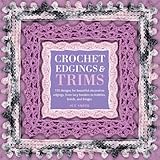
Crochet On The Edge


Crochet Edgings & Trims
Susan Smith

In A Nutshell: Good source book for 150 crochet trims with clear photos and good technical instruction but lacks inspiration

This is one of those books that does exactly what is says on the tin, no more, no less. It is a source book for 150 crochet trims, grouped by edgings, fringes, braids, motifs and accessories. Come here when you are looking for a shell edge to finish your top, an interesting fringe for a cushion or a motif for your beret.

Each of the samples are photographed clearly in attractive colour schemes so it is easy to compare and contrast to find what you are looking for. The technical bit of how to make each item is provided in a separate section.

Five projects are also provided, using trims to decorate a bolero, cardigan, cushion, shirt and beret. My main criticism is that the book could have been much more inspiring in providing examples of how trims can actually be used. The projects included are predictable and unexciting.

I will refer to this book when I am looking for the how-to for something specific, but will seek crochet inspiration elsewhere.


Tuesday, 8 February 2011

Reimagine, Reuse and Reinvent


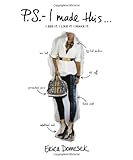
PS – I Made This
Erica Domesek

In A Nutshell: 25 ingenious projects for accessories and clothes to create your own New York style

I feel I am absorbing cool, hip New York style just by reading this book. Super stylist Erica Domesk claims to have DIY in her DNA and proves it with 25 runway inspired projects. Her philosophy is “Can you paint, embellish, cut, add to or adorn something similar to get the look or feel you’ve just fallen for?” I like to think I have a similar attitude but have only a fraction of Erica’s creative ingenuity.

She shows you how to make a variety of innovative jewellery, accessories and clothes. Some were a step too far for me – I certainly couldn’t imagine wanting to wear a string of bouncy balls in a pair of tights around my neck. Others, like the cork earrings, ring necklace and rhinestone studded heels were much more covetable. I’ve seen jewel encrusted shoes in the shops this spring, and a glue gun may be just the way to get the look for a fraction of the cost.

Erica’s trademark is to include mood boards for each piece, showing the inspiration behind each project. They immediately make you want to design your own.

The book also contains some interesting website suggestions, though the shopping sites would be of most use to American readers.

If the book leaves you wanting more, you can check out Erica’s own website.  


Monday, 7 February 2011

Will I Become An Embroidery Addict?


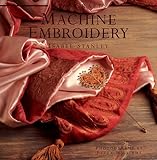
Machine Embroidery
Isabel Stanley

In a Nutshell: Beautifully illustrated book demonstrating the breadth and versatility of machine embroidery with 25 projects

Kirstie Allsopp memorably called machine embroidery the “crack cocaine” of the craft world, so I have been wondering whether I need a fix. In pursuit of more information I randomly picked up this book from the library, instantly seduced by the striking photos. I was quite surprised to find it had been published back in 1996 as there is a very modern feel to it.

It has 25 projects, designed to form a complete course in machine embroidery and covers free stitch, appliqué cut work, shadow work and open work. There are clear explanations of the basic techniques, all illustrated with clear photos.

The book contains a gallery of items made by leading exponents of the craft and I marvelled at the diversity of what can be achieved. Isabel says machine embroidery is for “people with limited patience whose priority is creativity over occupation”. However, many of the projects in the book will require endless supplies of patience and attention to detail. Though I think in many cases the stunning end results may make this worthwhile.

My favourite project was a shadow appliqué shirt. I’d love to create my own unique fabric and have a truly one-off piece of clothing. Perhaps one day I’ll get round to it.


Wednesday, 2 February 2011

Knitting Up Instant Gratification


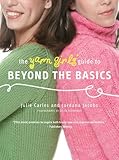
The Yarn Girls Guide To Beyond The Basics
Julie Carles and Jordana Jacobs

In A Nutshell: 34 fun, stylish patterns knitted in chunky yarn for quick results

I know when I’ve enjoyed a book when I immediately looked to see if the author’s have written anything else. Fortunately The Yarn Girls have obliged so I have already ordered their earlier work “The Yarn Girls Guide to Beyond The Basics” from the local library. Thanks to the wonders of Ravelry I was also able to check out their complete knitting oeuvre.

This book is entitled “Beyond The Basics”, but none of the designs are particularly difficult. Furthermore, they are knitted on large needles with chunky wool, so they are as close to instant gratification as knitting can get. 34 patterns cover a variety of pullovers, cardigans, ponchos, hats, scarves and blankets. They are excellent simple styles with a twist, exactly the sort of stuff I like to knit. I’ve picked out a striped cardi, A-Line pullover, and flared hat as future projects. What really endeared me to this book, was the little intro to each pattern, describing the person who had inspired the design.

I do have some criticisms. Some of the information could have been provided in a more understandable format. I’d normally check for bust measurement to determine which size to knit. Here the width was given, e.g. 17.5”, so it was necessary to double this figure to find the correct size. Only three sizes are provided for each pattern, so they are only suitable for standard sized people. The weight of the yarn isn’t given, so it isn’t simple to work out a possible substitution. It would also have been useful if more help could have been provided in how to adapt a pattern. I’d frequently like a sweater shape, but would like to change a neckline.

Saying all this, I still love The Yarn Girls and look forward to seeing more from them.


Restyling A Classic Piece


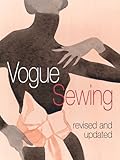
Vogue Sewing
Revised and Updated

In A Nutshell: Elegant and stylish book explaining the sewing techniques required to achieve a professional standard.  

I feel I am treading on hallowed ground in even attempting to review this classic book, originally published more than 40 years ago. Its high reaching aim is to elevate the craftsmanship of an amateur sewer to a professional level. As such, it has a wide scope, taking a beginner from analysing their figure, choosing a pattern and fabrics, sewing equipment, pattern alterations, construction techniques, tailoring and adding a custom touch.

One of my favourite chapters concerns fashion analysis and explaining the fundamental concepts of design. This section puts many “How to Dress” books to shame with useful pointers in choosing flattering and attractive outfits. I particularly enjoyed the exposition on the use of line and in future I will be thinking much more carefully about my use of horizontals and verticals.

This is an elegant and stylish book which I am pleased to have on my bookshelf. However, I have to admit this is not my go-to reference book when I want to look up a sewing technique. That honour belongs to the Readers Digest Complete Guide to Sewing which has the edge in providing detailed and clear explanations.

The Vogue book would have benefited from more photos. For example, a lovely chapter on creative trims is illustrated with line drawings. These are charming but I would have been more inspired by an actual photo.

Despite a few drawbacks, Vogue Sewing is a beautifully written book well worth adding to a sewing library.